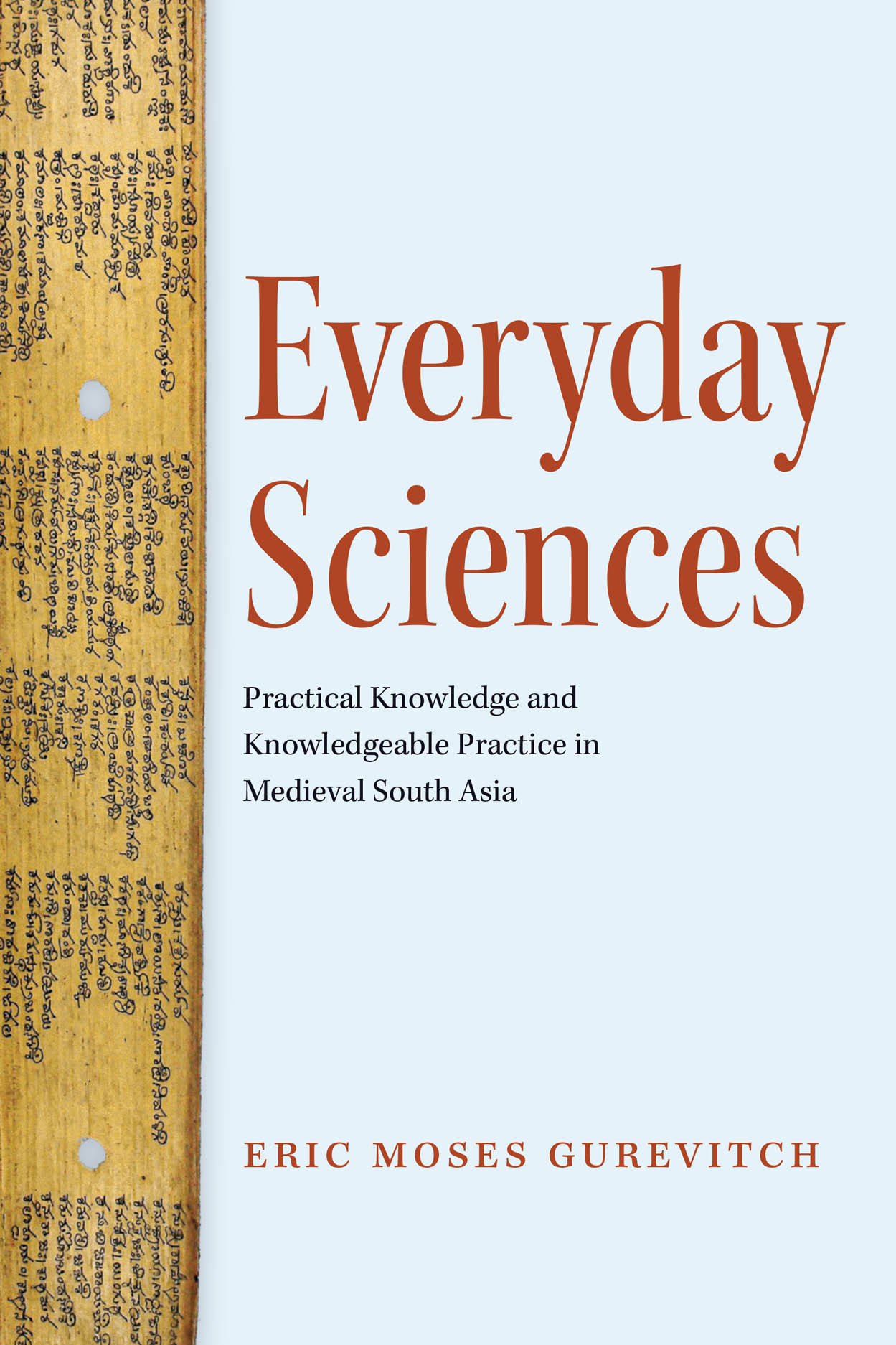
Everyday Sciences
Practical Knowledge and Knowledgeable Practice in Medieval South Asia
Everyday Sciences
Practical Knowledge and Knowledgeable Practice in Medieval South Asia
How people across society in medieval South Asia—including coppersmiths, merchants, bureaucrats, philosophers, and physicians—pioneered new vernacular sciences.
Starting in the eleventh century, South Asian scholars and artisans began to investigate and shape the world in a novel manner. Intellectuals translated Sanskrit texts into regional languages such as Kannada, situating knowledge in particular places. At the same time, architects and artisans began to assert their intellectual and literary presence, often claiming the title of “scholar” as they negotiated a space between classical textual erudition, professional expertise, and personal experience. Working within the perilous world of court politics, a new class of scholar-administrators began collecting recipes and composing texts about weather prediction, horticulture, mathematics, astrology, sexual life, and medicine.
Everyday Sciences traces this emergence of vernacular sciences by engaging with untapped archives and an array of sources in multiple languages. By exploring how historical actors resolved disputes about the physiology of vision, the use of meat and alcohol in medicine, and the management of information in elephant stables, Eric Moses Gurevitch unveils the complex textual and social orders that structured medieval society in India. He argues that a focus on everyday sciences in the non-modern non-West allows historians to reassess how places outside—and even inside—Europe are brought into narratives of a global history of science. Gurevitch articulates a “big-enough” history of science in South Asia, one open to little voices and unexpected connections that might not make their way through the fray in other histories.
Everyday Sciences demonstrates how practical, everyday activities were engines of profound intellectual innovation—and it shows the promise of revisiting the past without colonial hang-ups, and with fresh eyes.
344 pages | 16 color plates, 38 halftones | 6 x 9
Asian Studies: South Asia
History: History of Technology
Reviews

Table of Contents
Maps
Introduction: Big-Enough Histories of Science and Technology
1. Who Is a Scholar?
2. Who Is a Maker?
3. What Language Is Science?
4. Who to Trust?
5. What Is Perception?
6. Is Knowledge Local?
7. Can Knowledge Move?
Conclusion: The Problem of Sciences in the Nonmodern Non-West
Acknowledgments
Notes
Bibliography
Index
Awards
American Institute of Indian Studies: Indira Peterson Prize in Sanskrit Studies
Won