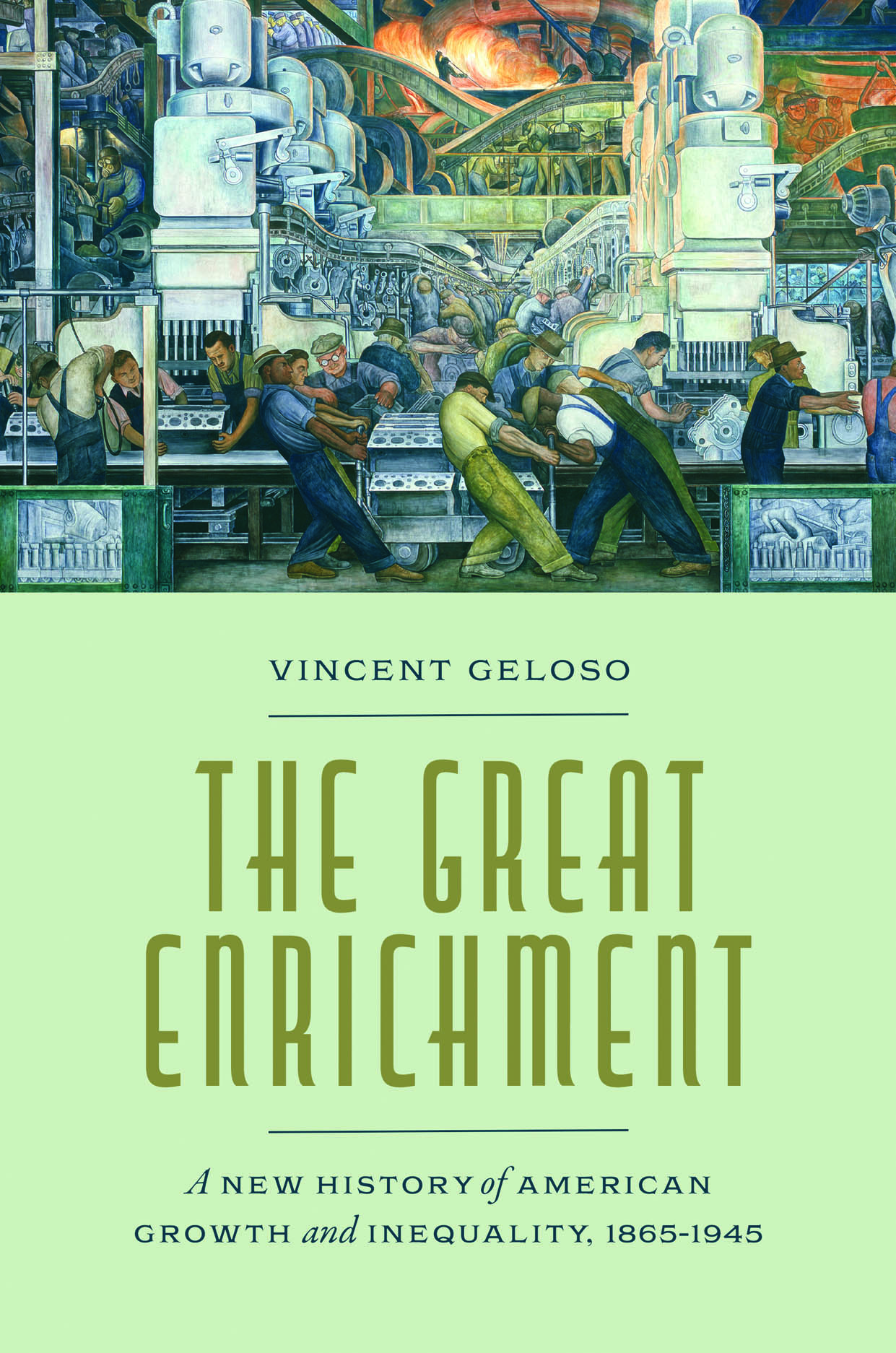
The Great Enrichment
A New History of American Growth and Inequality, 1865–1945
The Great Enrichment
A New History of American Growth and Inequality, 1865–1945
A revelatory economic history of America’s Gilded Age—and how it wasn’t just the Robber Barons who benefited.
The Gilded Age, spanning the late nineteenth and early twentieth centuries, was when Americans got rich. Or, rather, some Americans got rich. Because as much as the era is synonymous with staggering economic growth, it also doubles as America’s cautionary tale for the perils of leaving rich people and institutions unregulated. It was the time of extractive industrialists, worker exploitation, stifled economic mobility, and racial exclusion—lessons that the United States learned the hard way.
Vincent Geloso contests this traditional narrative by revisiting the math in this new empirical account of the Gilded Age. The Great Enrichment is an economic history of America’s rise to affluence, a period that doubled as a remarkable rise of the country’s economic floor. The conventional contrast of Robber Barons against huddled masses is, in Geloso’s analysis, unsubstantiated by economic data. The Gilded Age was the first egalitarian enrichment that humanity witnessed—a time when both rich and poor benefited in ways that were seismic, albeit unequal. Yet the net result was a great leap forward, not the lamentable birth of modern inequality.
Geloso marshals an expanded set of economic measures to account for factors not typically included in the Gilded Age economic story. The Great Enrichment sets a new standard for empirical history in one of America’s most consequential—and perhaps misunderstood—periods.
224 pages | 12 halftones, 3 line drawings, 17 tables | 6 x 9
Markets and Governments in Economic History
Economics and Business: Business--Industry and Labor, Economics--History
History: American History

Table of Contents
Chapter 1. Introduction
Chapter 2. The Usual Story and the Dissent
Chapter 3. From Cheap to Cheaper: America as the Best Poor Man’s Country
Chapter 4. Counting the Missing Poor: Health Leveling and Census Under-Enumeration
Chapter 5. Lifetime Earnings
Chapter 6. Immigration and Composition Bias
Chapter 7. When Tax Dodging Was Everyman’s Business
Chapter 8. The Lean and Mean Egalitarian Growth Machine from 1870 to 1910
Chapter 9. As Conclusion: The Great Deviation of the Wars and the Interwar Period
Acknowledgments
Notes
References
Index