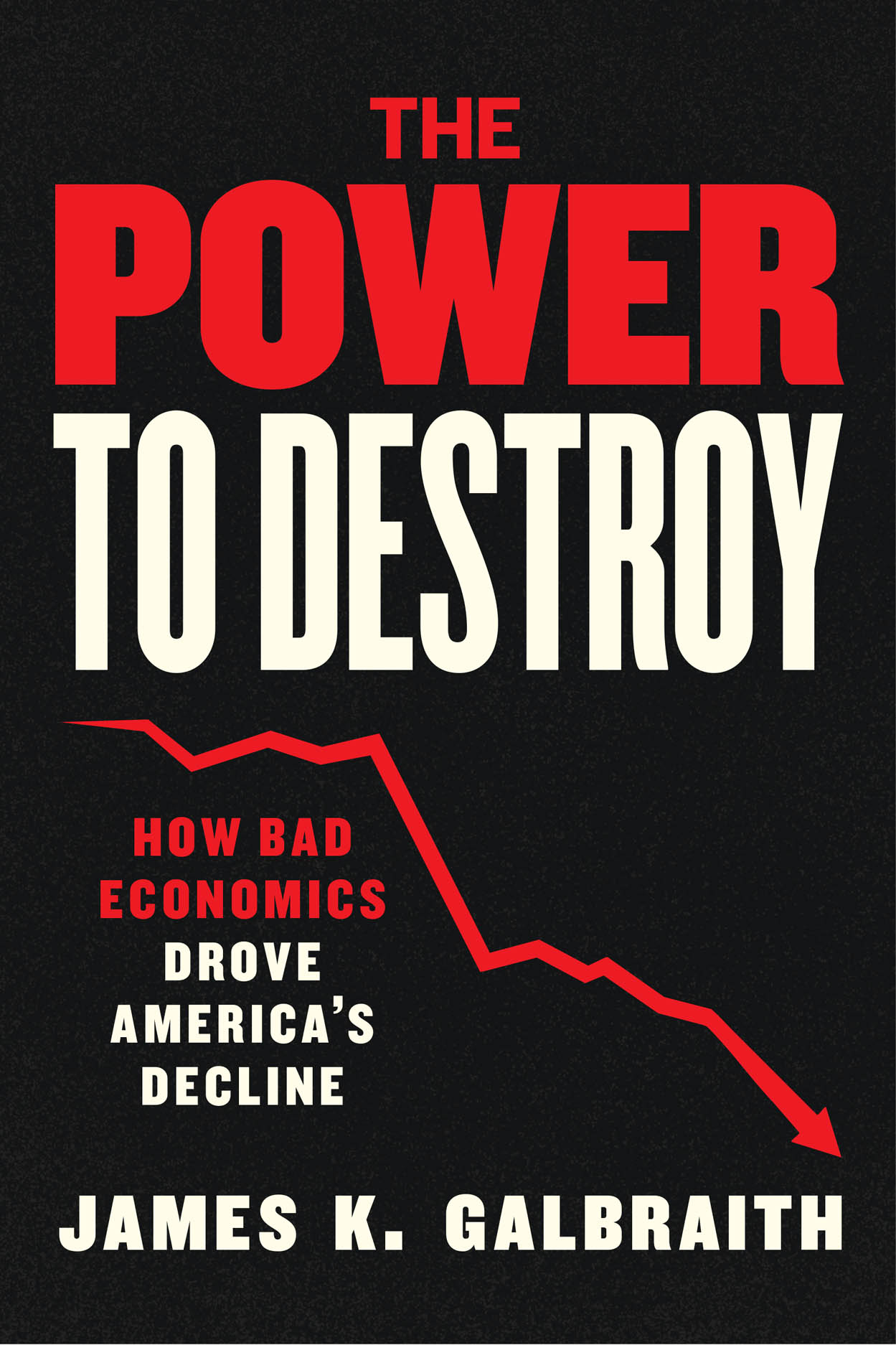
The Power to Destroy
How Bad Economics Drove America’s Decline
The Power to Destroy
How Bad Economics Drove America’s Decline
Acclaimed economist James K. Galbraith sounds an urgent alarm: how conventional economic ideas and policies are unequipped to account for the most daunting challenges of our geopolitical moment.
Amid a mounting sense of American decline, Americans live with a new kind of dissonance: economists announcing that everything is fundamentally fine. Where growth is steady, unemployment is low, prices are (somewhat) stable, and stocks are high—what’s there to worry about?
The Power to Destroy shows that this dissonance reflects a failure to evolve. James K. Galbraith’s incisive history of economic policy in this century is grounded in the fundamental problem that today’s experts are still deploying tools from all yesterday’s wars: obsolete economic ideas, measures, and doctrines focused on market functioning and crude economic indicators like output and prices. These methods, many of them honed a century ago against a vastly different social landscape, offer little hope in the face of today’s more existential threats.
Such conventional policies, Galbraith argues, are increasingly ill-equipped to counter the daunting challenges of our moment—from inflation to trade sanctions, industrial cold wars, and climate change—and, left unacknowledged, are accelerating the end of the US economy as we know it. Shortcomings include the weak responses to the inflation of 2021-2022; the sanctions war against Russia; the rise of China; the weak and ineffective attempt at industrial revival; and the impending demographic crisis. All have roots in a flawed body of outdated economic thought that has been sustained for ideological rather than practical reasons. They now promise to hinder the United States in the emerging multipolar world.
As Galbraith makes plain, for all the virtues of the market system, governments and their policies make markets possible. The ideas behind the policies—for better or worse—will determine the fate of the US economy—and new and better ideas are urgently needed. The alternative—sticking with economic ideas and policies we know and currently use—brings the power to destroy us all.
280 pages | 6 x 9 | © 2026
Economics and Business: Economics--Government Finance
Political Science: Diplomacy, Foreign Policy, and International Relations
Reviews

Table of Contents
1. Things Known
2. No One Saw It Coming
3. The Rules-Based Order
4. Papered Over with Money
5. Inflation, Misunderstood
6. Delusions of Balance
7. Dreams of Revival
8. The Supply Chain
9. The Gift of Sanctions
10. The Multipolar Future
11. Will Austerity and Precarity Finish Off the Human Species?
12. Summing Up: A Long Telegram for Our Times
Epilogue: On Democracy in America Now
Acknowledgments
Notes
References
Index