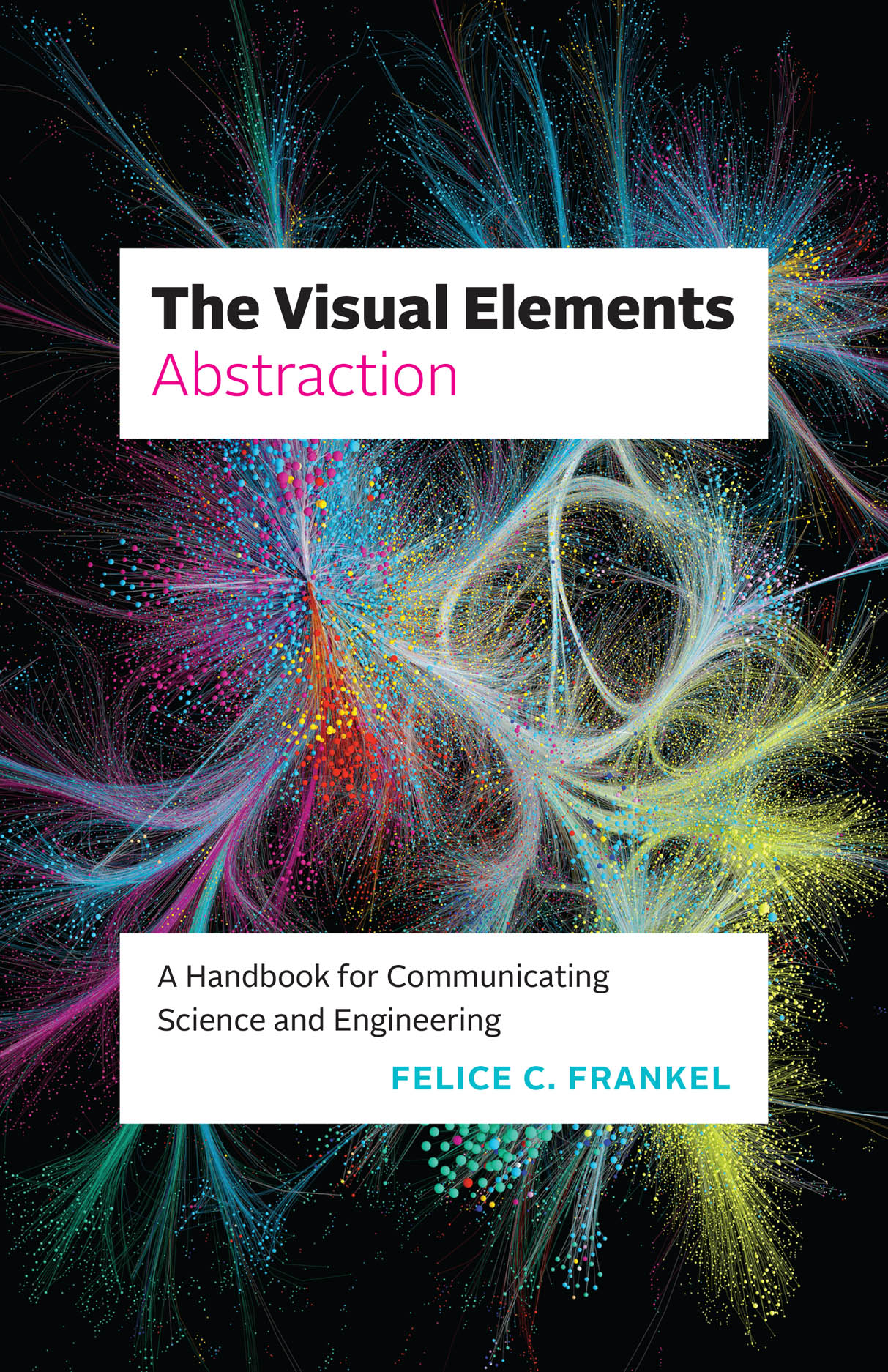
The Visual Elements—Abstraction

A Handbook for Communicating Science and Engineering

For anyone interested in visual communication, a training guide for evaluating and developing visual representations for the big ideas in science and technology, essential skills for journal submissions, grant applications, and public understanding.
 
As a scientist, engineer, or other researcher, you may have written an abstract. In a paragraph, you explain the purpose of your research, your approach, the questions you have asked and answered, and your work’s impact. The abstract is a summary and an invitation—to read the paper, attend your talk, and join you in your thinking. You may even have been asked to create a visual abstract—a single image—to achieve the same goals. As a designer or public information officer, you may have had a similar brief—to explain a compelling subject with a visual for a journal cover or press release. And yet, this important skill—devising visual metaphors—isn’t typically taught. With her decades of experience creating compelling images and instructing MIT researchers, award-winning photographer and science communicator Felice C. Frankel helps readers evaluate and create their own visual abstractions.
 
Like in her other books in the Visual Elements series, on photography and design, Frankel asks readers to evaluate different choices—for example, in conveying the uncertainty of a hurricane’s path or the organization of the Standard Model for elementary particles. But in Abstraction, she offers more. With examples from science, engineering, and beyond, the book helps readers consider and evaluate the visuals around them and determine how they work and when they fail: Is this representation the best for communication? Will these abstractions encourage others to engage with my work? Will they mislead? Will they help my ideas evolve? Frankel invites researchers to think about the many meanings behind their images—and, in turn, to think more deeply about their research.


208 pages | 186 color plates, 28 halftones | 5 1/2 x 8 1/2 | © 2026

The Visual Elements

Biological Sciences: Biology--Systematics

Chemistry

Design

Guides, Manuals, and Reference: Guides for Scientists, Guides to Visual Communication and Design

Reviews

“Frankel is a pioneer in her field who has helped many scientists visualize their work in interesting and effective ways. This latest book in her series highlights a region of unexplored territory. It is not so much a ‘how-to’ for accomplishing certain effects (or avoiding common blunders) but rather an invitation to think more broadly about what the visual abstract should convey and how to do it in simple terms. An exciting addition.”

Sidney R. Nagel, Stein-Freiler Distinguished Service Professor, Department of Physics, University of Chicago

“Frankel has made a name for herself by helping scientists augment their work with pictures that capture, represent, and communicate science, including many journals’ cover photos. . . . ‘It’s not about pretty pictures,’ she says. ‘It’s really about communication. And pushing the researcher to think beyond the good enough.’”

Science, on The Visual Elements series

“Should be on the desks of all researchers, engineers, and science communicators.”

The Well-read Naturalist, on The Visual Elements series

“An accessible guide for scientists and engineers to learn how to create graphics to illustrate their work. [Frankel] delves into the importance of thinking visually and what that really means, as well as provides case studies and advice.”

American Scientist, on “The Visual Elements—Design”

“This book makes you think more deeply about how you present your research and how you communicate with your audience. . . . [Recommended] to all scientists and illustrators of science.”

The Marine Biologist, on “The Visual Elements—Design”

“Eminently sensible. . . . A valuable addition to the aspiring scientist’s bookshelf.”

Metascience, on “The Visual Elements—Design”

“Compelling. . . . Loaded with stunning visuals. . . . A useful and accessible guide that gives a holistic view.”

Visual Resources Association Bulletin, on “The Visual Elements—Photography”

“It is rare that a book inspires creativity and is at the same time so useful and instructive.”

American Journal of Physics, on “The Visual Elements—Photography”

“An outstanding resource with thoughtful analysis of the best practices intended for anyone interested in improving their communication through information visualization.”

Technical Communication, on “The Visual Elements—Photography”

Table of Contents

Introduction
1. Illustrations
2. Notations
3. Systems
4. Uncertainty
5. Metaphors
6. Picturing the Future

Acknowledgments
Notes
Credits

Be the first to know

Get the latest updates on new releases, special offers, and media highlights when you subscribe to our email lists!

Sign up here for updates about the Press