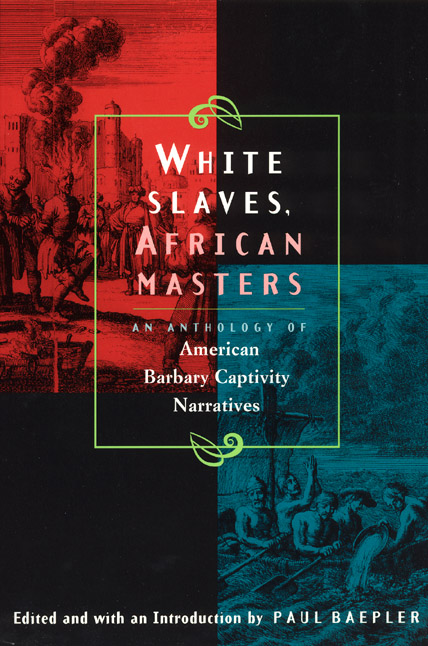
White Slaves, African Masters
An Anthology of American Barbary Captivity Narratives
9780226034041
White Slaves, African Masters
An Anthology of American Barbary Captivity Narratives
A remarkable collection of hard-to-find primary source accounts of nineteenth-century American captivity narratives
Some of the most popular stories in nineteenth-century America were sensational tales of whites captured and enslaved in North Africa. White Slaves, African Masters for the first time gathers together a selection of these Barbary captivity narratives, which significantly influenced early American attitudes toward race, slavery, and nationalism.
Though Barbary privateers began to seize North American colonists as early as 1625, Barbary captivity narratives did not begin to flourish until after the American Revolution. During these years, stories of Barbary captivity forced the U.S. government to pay humiliating tributes to African rulers, stimulated the drive to create the U.S. Navy, and brought on America’s first post-revolutionary war. These tales also were used both to justify and to vilify slavery.
The accounts collected here range from the 1798 tale of John Foss, who was ransomed by Thomas Jefferson’s administration for tribute totaling a sixth of the annual federal budget, to the story of Ion Perdicaris, whose (probably staged) abduction in Tangier in 1904 prompted Theodore Roosevelt to send warships to Morocco and inspired the 1975 film The Wind and the Lion. Also included is the unusual story of Robert Adams, a light-skinned African American who was abducted by Arabs and used by them to hunt negro slaves; captured by black villagers who presumed he was white; then was sold back to a group of Arabs, from whom he was ransomed by a British diplomat.
Long out of print and never before anthologized, these fascinating tales open an entirely new chapter of early American literary history, and shed new light on the more familiar genres of Indian captivity narrative and American slave narrative.
Though Barbary privateers began to seize North American colonists as early as 1625, Barbary captivity narratives did not begin to flourish until after the American Revolution. During these years, stories of Barbary captivity forced the U.S. government to pay humiliating tributes to African rulers, stimulated the drive to create the U.S. Navy, and brought on America’s first post-revolutionary war. These tales also were used both to justify and to vilify slavery.
The accounts collected here range from the 1798 tale of John Foss, who was ransomed by Thomas Jefferson’s administration for tribute totaling a sixth of the annual federal budget, to the story of Ion Perdicaris, whose (probably staged) abduction in Tangier in 1904 prompted Theodore Roosevelt to send warships to Morocco and inspired the 1975 film The Wind and the Lion. Also included is the unusual story of Robert Adams, a light-skinned African American who was abducted by Arabs and used by them to hunt negro slaves; captured by black villagers who presumed he was white; then was sold back to a group of Arabs, from whom he was ransomed by a British diplomat.
Long out of print and never before anthologized, these fascinating tales open an entirely new chapter of early American literary history, and shed new light on the more familiar genres of Indian captivity narrative and American slave narrative.
324 pages | 19 halftones | 6 x 9 | © 1999
History: American History
Literature and Literary Criticism: American and Canadian Literature
Travel and Tourism: Tourism and History
Reviews

Table of Contents
Introduction
Cotton Mather: The Glory of Goodness
John D. Foss: A Journal, of the Captivity and Sufferings of John Foss
James Leander Cathcart: The Captives, Eleven Years in Algiers
Maria Martin: History of the Captivity and Sufferings of Mrs. Maria Martin
Jonathan Cowdery: American Captives in Tripoli
William Ray: Horrors of Slavery
Robert Adams: The Narrative of Robert Adams
Eliza Bradley: An Authentic Narrative
Ion H. Perdicaris: In Raissuli’s Hands
Appendix: Publishing History of the American Barbary Captive Narrative
Cotton Mather: The Glory of Goodness
John D. Foss: A Journal, of the Captivity and Sufferings of John Foss
James Leander Cathcart: The Captives, Eleven Years in Algiers
Maria Martin: History of the Captivity and Sufferings of Mrs. Maria Martin
Jonathan Cowdery: American Captives in Tripoli
William Ray: Horrors of Slavery
Robert Adams: The Narrative of Robert Adams
Eliza Bradley: An Authentic Narrative
Ion H. Perdicaris: In Raissuli’s Hands
Appendix: Publishing History of the American Barbary Captive Narrative