Distributed for Tupelo Press

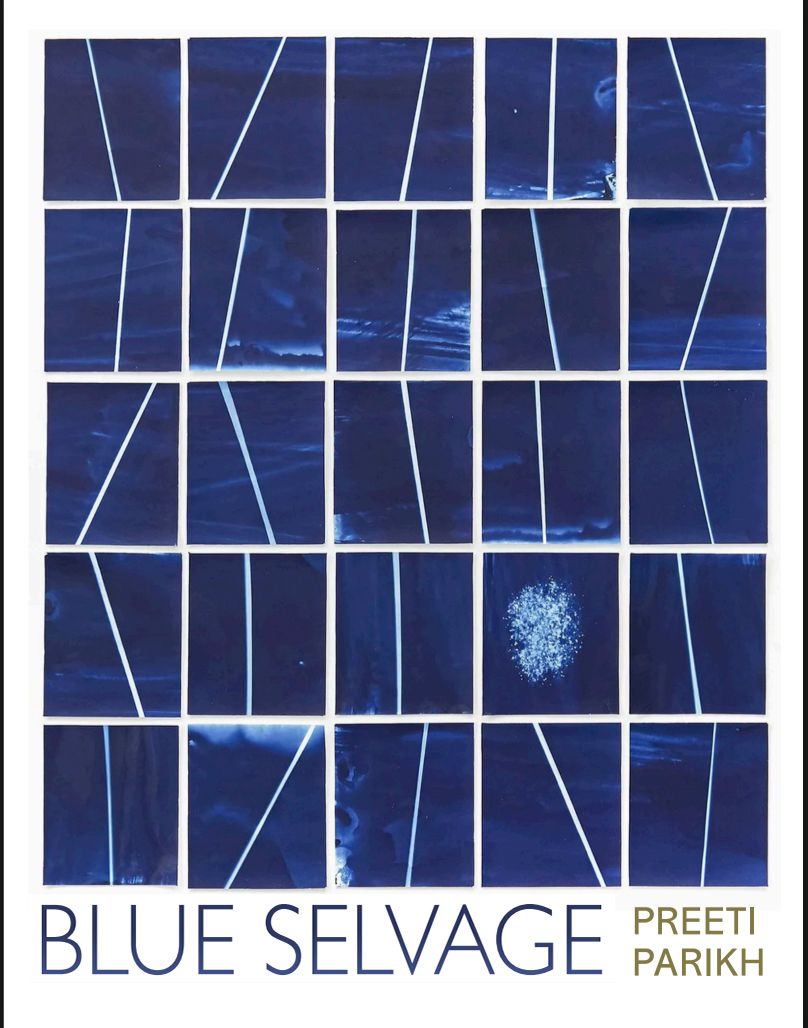
Blue Selvage

Blue Selvage reminds us that a revolutionary message often requires new forms of discourse. 

The poems in Blue Selvage weave lyric, essay, documentary fragments, and historical reckoning into an exploration of skin, cloth, color, and form as living archives—where the gendered, racialized, and colonial histories inscribed on the body are continually exposed, resisted, and re-stitched through memory, touch, and language itself.

Preeti Parikh’s debut poetry collection is a mapping of boundaries, a (re)framing of fractured interiority, a text(ile) unfurling across shifting homelands. In this deeply embodied, formally daring meditation, the corpus is both archive and threshold, a site where “what’s felt becomes the body, what’s draped becomes form.” Here, passion for indigo, a medical-science informed perspective, fascination with the materiality of cloth and skin, and a journeying towards reclamation interlace with feminist inquiries and cultural examination to conceptualize the poems’ multivalent inhabitances. 

Expansive in its rhetorical modes and landscapes, Blue Selvage is unified by a remarkable singularity of voice and vision through which Parikh skillfully invokes form as metaphor, performance, dramatization, and content. Throughout the book, recurrent vocabularies and silences—integument, selvage, gaze—operate as warp and weft, binding personal experience to collective striving, devotion, and survival. Meanwhile, on the page, multilingual textures and typographic openness resist closure, offering apertures for looking within and without. What emerges is a capacious field of attention, where intimacy and history press against one another, and where writing itself becomes an act of unstitching and re-making—an ethical, sensuous practice of staying with what the body remembers and what culture would prefer to erase.


76 pages | 7 x 9 | © 2026

Poetry


Tupelo Press image

View all books from Tupelo Press

Reviews

“The artistry of Preeti Parikh’s debut collection, Blue Selvage, is one of daring precision—an embroidery of vivid, textured language that explores the instability of boundaries and the implications of integument: cover and exposure, clothing and skin, diaspora and the “dreamcloth” of identity. This is the poetics we need today, one that deeply enacts the decentralization of power by meditating on edges both frayed and selvaged and traversing the thresholds of body, language, culture, and memory. Parikh’s multi-lingual, multi-modal tapestry is beautiful, articulate, and brave. A refreshing and liberating voice!”

Jennifer Elise Foerster, Author of The Maybe Bird

“Poetry as the work of embodiment, of transformation—this principle manifests as a gorgeous new expression in Blue Selvage. But as Preeti Parikh shows, the arc towards self-realization is also about the tensions between raveling and unraveling, stitching and unstitching, text and lacuna. Delving into the intimacy of memory and the violence of history, Parikh understands that “opacity and translucence” are both necessary to deep testimony. Bold in its forms and defiant in its truths, Blue Selvage is a radiant debut.”

Rick Barot, Author of Moving the Bones

“Blue Selvage is an inventive palimpsest of South Asian history and autobiography, unspooling the female body and the weight of its inheritance. Braiding memory with etymology, and medical terminology with the cadences of Hindi and Gujarati, Parikh navigates multiple geographies—clinical, domestic, diasporic. Here, fabric both covers and bares. The body is archive and anatomy, born a ’milky clump’ of cotton and marked by indigo’s colonial violence. This is fierce work on the gaze and its exposures, a reckoning with touch, shame, and desire that stains the reader’s mind blue and selvages the self. A stunning debut by a luminous new voice.”

Shikha Malaviya, Author of Anandibai Joshee, A Life in Poems

“Blue Selvage is a chronicle of dichotomies, both difficult and joyful. Preeti Parikh’s debut collection of poems is exhilarating. Here we find a convincingly modern mind — one formed in girlhood on one continent and evolving into an empowered woman and poet on another. The tensions of family and culture explored in this book are numerous: what’s lost and what’s found; what’s private and what’s a violation; what’s a mask and what’s a face; what is broken and what is healed. The concentrated, formally varied poems weave shame and empowerment, the buried and the unearthed, the forgotten and the remembered. When Parikh writes, “let the fabric breathe,” she is conveying complexities of feeling, fluency, and morality that any reader will recognize as clarity and grace.”

David Biespiel, Author of Beautiful Is the World

Be the first to know

Get the latest updates on new releases, special offers, and media highlights when you subscribe to our email lists!

Sign up here for updates about the Press