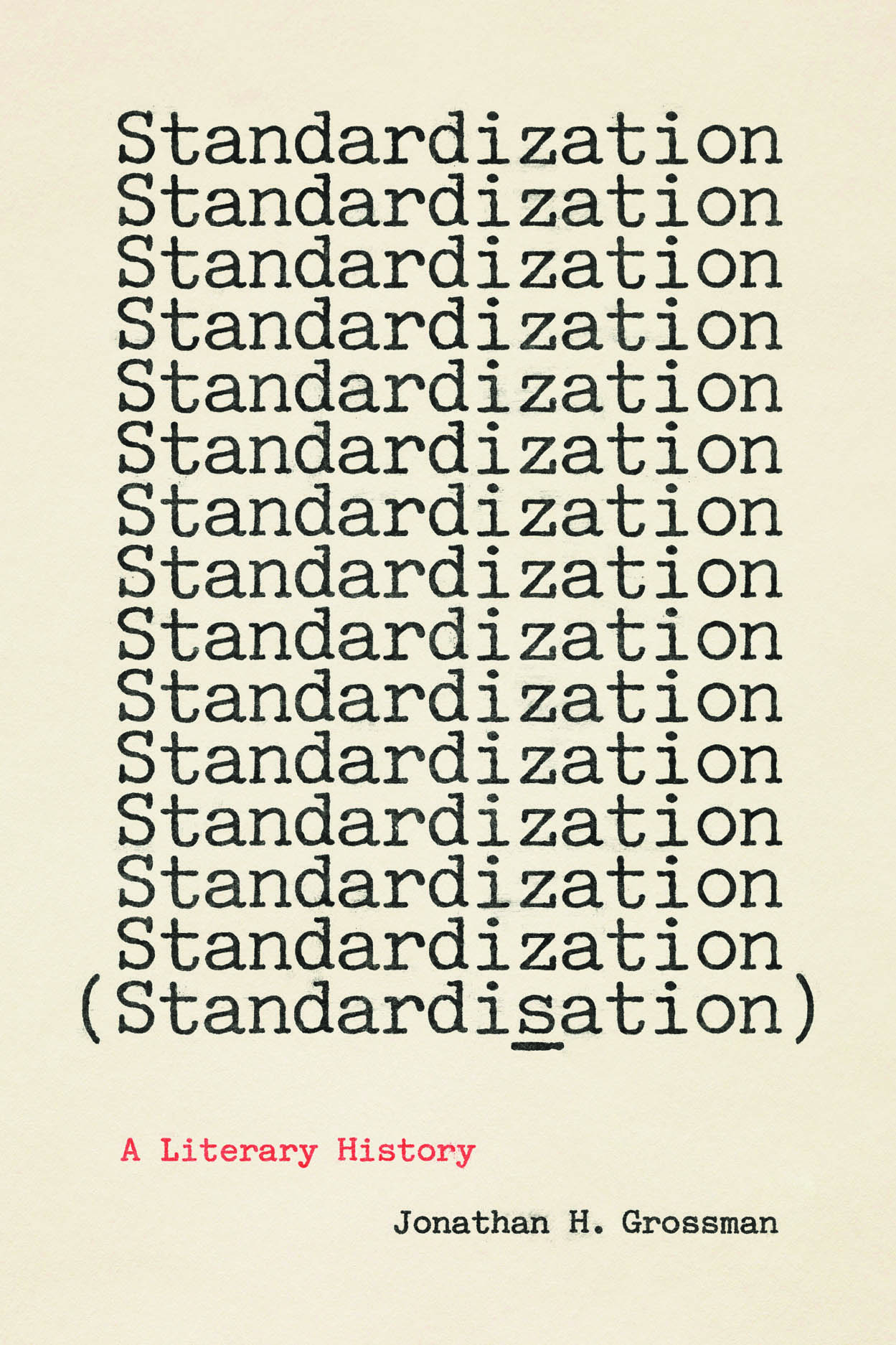
Standardization (Standardisation)
A Literary History
Standardization (Standardisation)
A Literary History
An innovative study of the history of standardization that draws on both technical documents and novels.
Jonathan H. Grossman’s elegant analysis of standardization approaches the topic by exploring how institutions create standards. Grossman tracks how published standards documents became the dominant means of homogenizing durable objects during the nineteenth century’s industrialization of manufacturing, including printing. Examining these documents as a genre, he reconstructs the nineteenth-century history of published standards documents and shows how they evolved to produce uniformity across manufactured objects.
Shifting focus from the standardized creation of objects to their use by subjects, Grossman then probes how people reimagined, through print, the ways in which their subjectivity combined with identical, interchangeable manufactured objects. To understand that relation, he looks to nineteenth-century novels by Charles Dickens, Mark Twain, and Elizabeth Gaskell, revealing how these books depicted the interchangeability of the subjects implied by this production of identical objects. The novels do not merely observe the interplay between subjects and standardized objects; they materialize it in the assemblage of readers holding their industrially manufactured, print copy.
240 pages | 10 color plates, 10 halftones | 6 x 9 | © 2026
History: History of Ideas, History of Technology
Literature and Literary Criticism: General Criticism and Critical Theory
Reviews

Table of Contents
Introduction
Part I: Objects
1. Measuring Objects
2. A New Genre
3. From Publications to Blockchains
Part II: Subjects
4. Subjects and Objects in the Novel: Charles Dickens’s Historical Fiction
5. The “American System” and Mark Twain’s Tech-Fiction
6. On a Uniform System for Disuniformity at Elizabeth Gaskell’s Cranford
Coda
Acknowledgments
Notes
Index