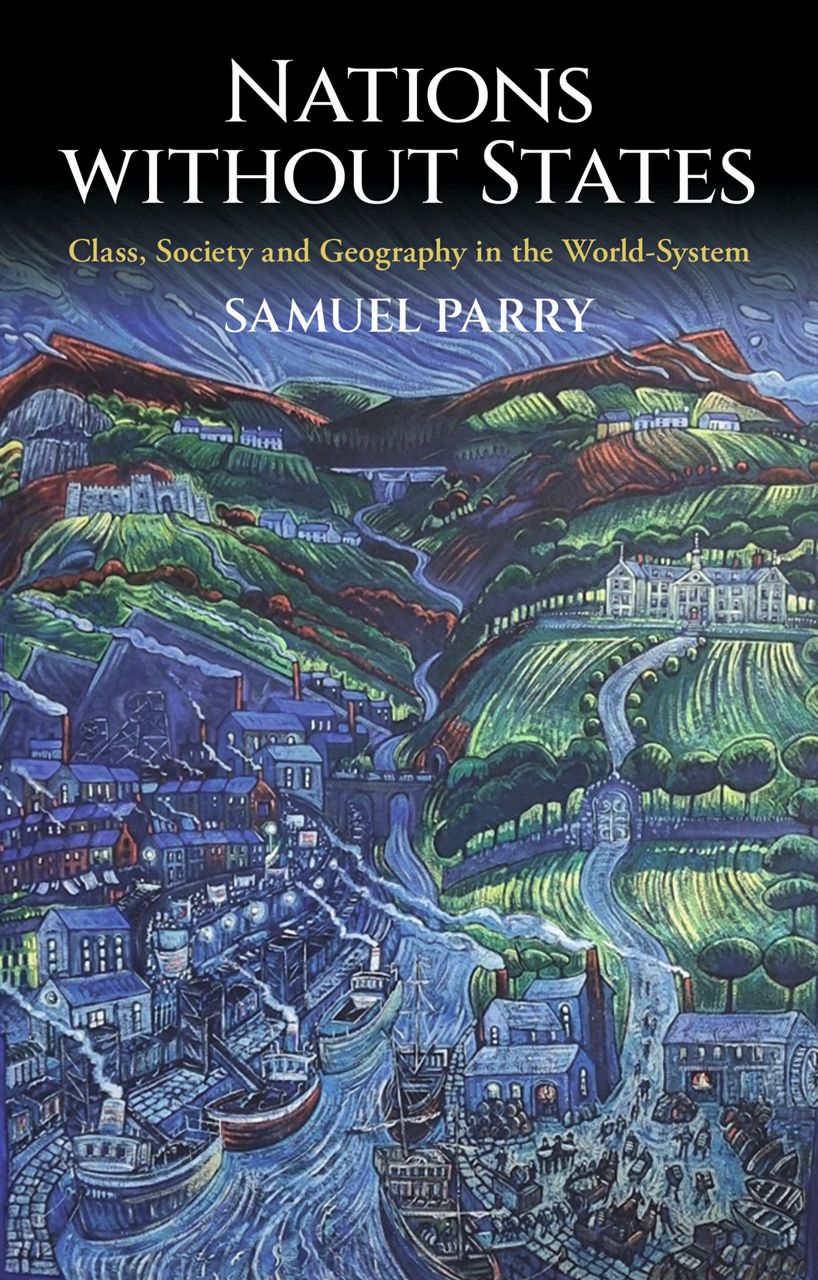
Distributed for University of Wales Press
Nations without States
Class, Society and Geography in the World-System
Offers a structural, long-term reinterpretation of Wales within the capitalist world-system.
Nations without States compares Wales’ development with Catalonia, the Mezzogiorno, and Padania to show how internal differentiation emerges within modern states. Rejecting methodological nationalism, it examines how Wales was shaped by conquest, administrative centralization, resource extraction, dependency, and uneven development across centuries. By placing Wales in direct comparison with other stateless or structurally distinct regions, the book reveals how political tensions and cultural resilience reflect deeper world-systemic roles rather than anomalies of identity or local history. It traces how state formation, economic functions, regional power, and global cycles have produced divergent outcomes that persist into the present. Through an integrated analysis of political economy, territorial governance, and historical sociology, the book demonstrates that Wales’s structural position—and those of comparative regions—reflects systemic imperatives that continue to shape autonomy debates, economic stagnation, and the contradictions of modern statehood.
272 pages | 5 maps, 10 graphs | 5.43 x 8.5 | © 2026
Economics and Business: Economics--History
History: European History
Political Science: Political and Social Theory


Table of Contents
PREFACE
INTRODUCTION
THEORETICAL UNDERPINNINGS
DEPENDENCY THEORY AND THE STAGIST VIEW OF DEVELOPMENT
Dependency Theory
Distorted Development
Limitations of Dependency Theory
UNIT OF ANALYSIS AND OBSERVATION
THE ANNALES SCHOOL AND THE LONGUE DURÉE
The longue durée
The conjoncture or Periodic History
L’histoire événementielle or Episodic History
WORLD-SYSTEMS ANALYSIS
The Periphery
The Semi-Periphery
States and Nations
Nationalism
CATALONIA AND SPAIN
Geography
THE CROWN OF ARAGÓN
The Catalan (Re)conquista
Late-Medieval Crisis
Union of Castile and Aragón
THE RECONQUISTA
The Process of Reconquest
Sugar and the new Frontiers
1492 AND THE DISCOVERY OF THE AMERICAS
Silver, Agriculture, and the Economy
1492 and the world-system
Spain of the 17th Century
BUILDING THE SPANISH STATE
The Catalan Economy
The fall of the Colonies and the Catalan Economy
The Catalan ‘Rebirth’
Ecology and Labour
1898, EMPIRE AND FASCISM
The rise of Catalan Nationalism
The Spanish Civil War and Facism
The Catalan Economy under Fascism
THE RETURN TO LIBERAL DEMOCRACY: CATALONIA IN THE WORLD-SYSTEM
Spain as Semi-periphery
Catalonia as Core?
CONCLUSION
THE MEZZOGIORNO, PADANIA, AND ITALY
Geography
The Roman Foundations of Italy
Italy and the Carolingian Empire
10th Century Situation
The Meeting of Christian and Islamic Worlds
THE ITALIAN CITY-STATE SYSTEM
The Economy of the City-State
Banking and Finance
The Development of the City-State System
The Guilds and Agriculture
Hidden Labour
The Social Superstructre
The Church
A FAILURE TO TRANSITION?
Long-distance Trade
The South
A Feudal Social Structure
The Changing Position of Italy within the World-System
THE FALL OF ITALY
Foreign Control
Reform
THE ITALIAN RISORGIMENTO
The Passive Revolution
The Risorgimento and the Roots of ‘The Southern Question’
The Southern Economy
Italian Colonialism
FASCIST ITALY AND THE POST-WAR PERIOD
Fascist Italy and the Changing Southern Question
Post-War Italy: A New Dawn?
Italy in the world-system After 1945
The Cassa Per il Mezzogiorno
ITALY SINCE THE 1990S: THE NATIONALISM OF THE NORTH
Padania: Inventing a Nation
It’s the Economy, Stupid.
The International Context
CONCLUSION
WALES AND BRITAIN
Geography
THE ANGLO-SAXONS AND POST-ROMAN WALES
The Normans and the Welsh March
Geographic Conditions and the Economy
THE TUDORS AND STATE CONSOLIDATION
The Acts of Union with Wales
The Reformation
THE BIRTH OF CAPITALISM
Agricultural Capitalism and its Foundations
The Parts and the Whole: The World-System and Agricultural Capitalism
Capitalism and Slavery
The Absence of Agricultural Capitalism in Wales
The ‘English’ Civil War
Wales and the ‘English’ Civil War
THE INDUSTRIAL REVOLUTION AND THE FOUR CHEAPS
Cheap Labour
Cheap Energy
Cheap Food
THE NATIONAL/IMPERIAL CONTRADICTION
Nonconformism and the Failure of Welsh Liberalism
Class Conflict in Wales
All That is Solid Melts into Air
POST-WAR (DIS)UNITY
Thatcherism
The Fall of Empire
‘New’ Wales, Old Problems
How Leave was my Valley?
CONCLUSION
THE PAST WE INHERIT, THE FUTURE WE BUILD
REFERENCES